Automated Tuning Targets Workstation Silicon
Hugging Face engineer Niels Rogge published a detailed optimization study showing how a coding agent accelerated serving performance for Inkling 2 Mini on a single 96 GB NVIDIA RTX PRO 6000 GPU. Released a week earlier, Inkling 2 Mini targets local and compact open-weight deployments with roughly 26 billion total parameters and 3 billion active parameters per token. While initial vLLM and SGLang serving recipes targeted datacenter NVIDIA B200 and GB300 accelerators on the sm100 architecture, the RTX PRO 6000 uses sm120 silicon where kernel support and optimal flags differ.
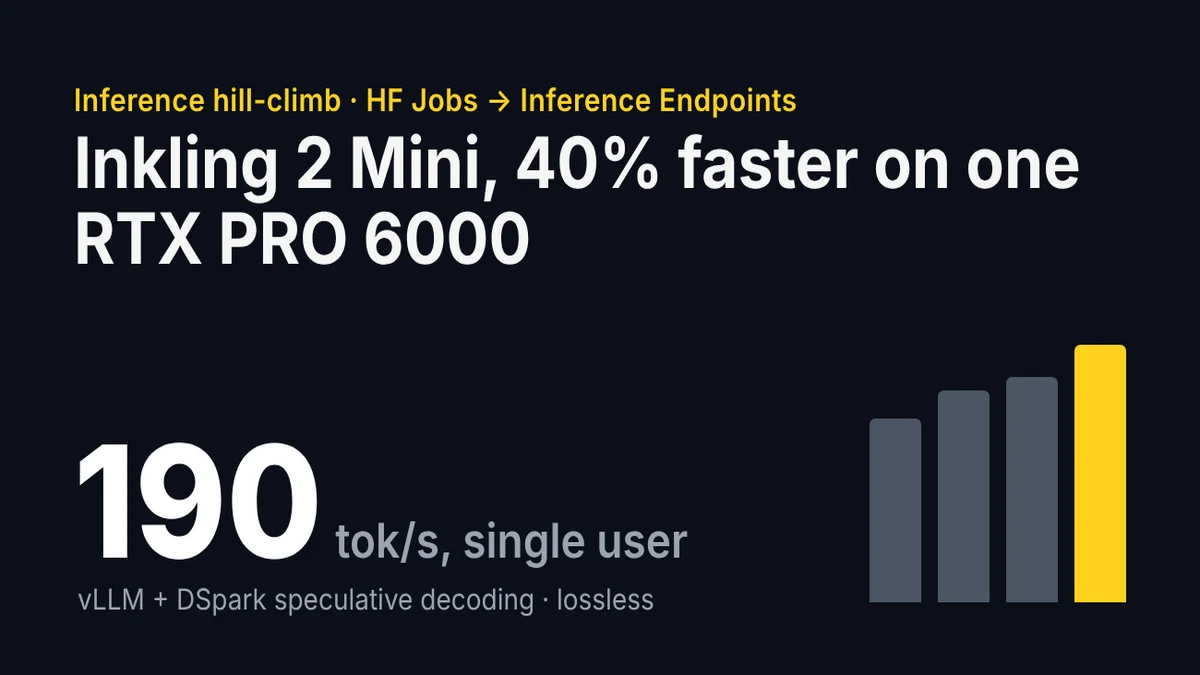
Rather than tuning flags manually, the team gave an agent the inference-optimisation skill, the hf CLI, and access to rtx-pro-6000 Hugging Face Jobs billed at $2.75 per hour. Because that Job tier uses the exact GPU backing the corresponding Hugging Face Inference Endpoint, results transferred directly from experimentation to production. Across 46 valid benchmark runs, single-user decode speed rose 40 percent from a 136 tok/s baseline to 190.6 tok/s, while eight-user aggregate throughput climbed 26 percent from roughly 570 tok/s to 716 tok/s.
Looped MoE Architecture and Bandwidth Physics
Inkling 2 Mini (thinkingmachines/Inkling-2-Mini) combines multimodal inputs and a 1-million-token context window with an unusual looped Mixture-of-Experts architecture. Its checkpoint holds 24 physical layers, but the middle 12 layers run three times so every generated token traverses 48 layers and routes through 8 of 128 experts per layer. Weights ship in mixed NVFP4 and MXFP8 precision alongside a bundled DSpark drafter for speculative decoding. Hugging Face reports that the model leads its weight class on the Artificial Analysis Intelligence Index v5 and across 32 of 48 benchmarks against Gemma 4 31B and Qwen3.8-27B.
Hardware probing on the RTX PRO 6000 measured 1,469 GB/s of copy bandwidth, 416 TFLOPS in BF16, and 792 TFLOPS in FP8. During standard decode across 48 layer visits, each token re-reads roughly 2.7 GB of dense and attention weights, 2 GB of routed experts, and 0.9 GB for the language model head, establishing a ~256 tok/s theoretical ceiling. Verifying eight speculative draft positions together alters that memory math by loading the union of routed experts—roughly 40 percent of each layer's experts instead of 6 percent. At the measured temperature 1.0 acceptance rate of ~2.3 tokens per step, the hardware ceiling drops to ~201 tok/s, meaning vLLM plus DSpark at 190.6 tok/s reaches roughly 95 percent of available memory bandwidth.
Controlled Benchmarks and Failed Experiments
The optimization harness enforced a strict control -> candidate -> control methodology driven by jobs/driver.py and an engine-agnostic bench.py script. Each test ran six prompts—code, explanation, story, comparison table, bash script, and history summary—at temperature 1.0 with thinking enabled, 512 output tokens, and 12 repetitions under speculation, logging every run to PLAN.md. When engine flags were undocumented, the agent spawned cpu-upgrade Jobs to inspect installed Python packages inside container images.
Moving from the baseline SGLang setup (--attention-backend fa4, 134–139 tok/s single-user, 543–598 tok/s eight-user) to vllm/vllm-openai:nightly without speculation boosted single-user throughput by 15 percent to 157.0 tok/s and dropped time-to-first-token to 33 ms. Enabling DSpark in vLLM produced 190.6 tok/s single-user, 716 tok/s eight-user, 20.7K/20.6K prefill speeds at 4K/32K prompts, and 40 ms TTFT—ahead of SGLang plus DSpark at 166.6 tok/s single-user and 660 tok/s at eight-way concurrency. The winning recipe pairs --max-model-len 262144 and --gpu-memory-utilization 0.85 with --speculative-config '{"method":"dspark","num_speculative_tokens":7,"draft_sample_method":"probabilistic"}' and the inkling tool-call and reasoning parsers.
Most candidate tweaks failed to hold up. Draft lengths of three to six tokens were rejected at startup because the checkpoint block size mandates seven drafts in vLLM and eight in SGLang. Greedy draft sampling cut vLLM decode speed by 11 percent to 168.6 tok/s, adaptive verification crashed at startup, and FP8 draft head quantization worked only for DeepSeek drafters. Lossy rejection methods were skipped deliberately, while SGLang flags such as SGLANG_ENABLE_NV_MEGA_RUNTIME_OPTIMIZATION=1 failed to beat fresh controls.
Deployment Verification and Developer Workflow Impact
Before shipping, the winning configuration passed greedy-equivalence checks proving byte-identical outputs with and without speculation, alongside 3-for-3 long-context needle retrieval up to 250K tokens. Deployed via hf endpoints deploy from a pinned container digest, the live endpoint achieved 194.9 tok/s single-user and 673 tok/s eight-user aggregate throughput over the internet, with 198 ms TTFT reflecting roughly 160 ms of network latency. By releasing all scripts and logs in NielsRogge/inkling-2-mini-hillclimb, the experiment gives open-source teams a reproducible blueprint for automating inference tuning on newer workstation GPUs.
Bandwidth Limits and Reporting Caveats
Several constraints bound these gains. Because vLLM plus DSpark already saturates 95 percent of RTX PRO 6000 memory bandwidth, further flag tuning offers almost no headroom without higher drafter acceptance at temperature 1.0 or verification kernels touching fewer experts. Fitting the model and speculative buffers inside 96 GB VRAM also required capping context length at 262,144 tokens rather than the full 1-million-token window. Finally, benchmark rankings against Gemma 4 31B and Qwen3.8-27B reflect Hugging Face-cited figures rather than independent testing, and the blog post does not specify the exact license governing Inkling 2 Mini's weights.
Automated Vertex AI (gemini-4-hydrogen) primary-source report; reviewed 2026-11-27.


