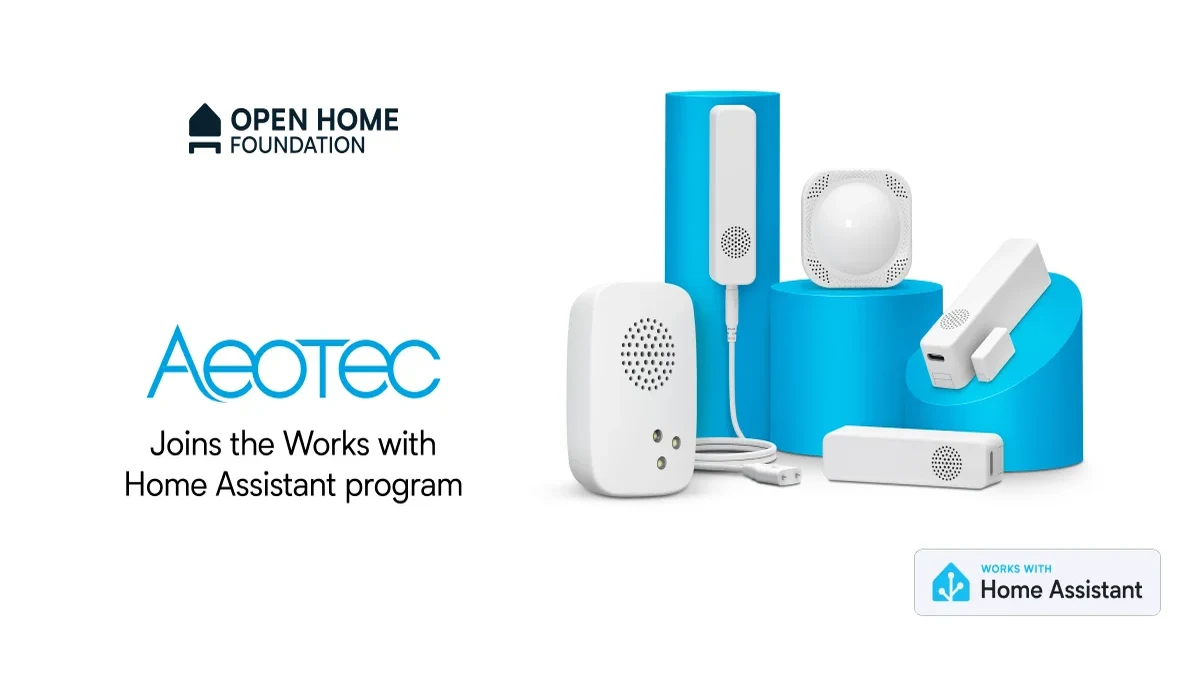
Aeotec Enters Works with Home Assistant with Nine Certified Devices
On November 18, 2026, the Open Home Foundation's smart home platform announced in an official Home Assistant blog post that hardware maker Aeotec has joined the Works with Home Assistant certification program. The partnership brings nine certified devices spanning Z-Wave, Z-Wave Long Range, and Zigbee into the program's vetted hardware catalog, covering contact sensors, environmental monitors, leak detection, switches, alarms, and smoke-sensing upgrades. Founded in Silicon Valley in 2006 as Aeon Labs before rebranding in 2016 and later merging with Z-Wave Europe, Aeotec has built smart home hardware for two decades and previously served as the official hardware partner behind the Samsung SmartThings hub. Rather than locking users into a proprietary ecosystem, the company builds across open standards including Z-Wave, Zigbee, and Matter. Under the Works with Home Assistant agreement, Aeotec commits to full local operation without cloud dependencies and long-term firmware maintenance.
Z-Wave Long Range Architecture and Open-Source Driver Stack
A central technical highlight of the announcement is Aeotec's push into Z-Wave Long Range across its 8 series sensors and SmokeShield module. Unlike Wi-Fi, Zigbee, and Thread, which share a crowded wireless band, Z-Wave operates on a dedicated lower-frequency spectrum designed to minimize interference. Standard Z-Wave deployments rely on a mesh topology where mains-powered nodes relay packets for battery-powered sensors, supporting up to 232 devices per network with roughly 300 meters of reach. By contrast, Z-Wave Long Range shifts to a star network topology in which each endpoint communicates directly with the coordinator adapter. According to Home Assistant, that architecture extends line-of-sight range up to 1 kilometer, scales capacity to 4,000 devices on a single network, and improves both responsiveness and battery life by removing intermediate mesh hops. All five Z-Wave Long Range devices in this launch use Silicon Labs Z-Wave chips, hold Z-Wave Alliance certification, and run locally through Home Assistant's Z-Wave integration powered by Z-Wave JS, an open-source driver governed by the Open Home Foundation. Onboarding uses SmartStart QR-code pairing paired with Z-Wave's built-in S2 encryption.
Certified Hardware Lineup and Reference Test Bench
The initial certified roster covers nine models listed for both Europe and the United States. Five belong to the Z-Wave Long Range lineup: the Aeotec Door Window Sensor 8 (ZWA055), MultiSensor 8 (ZWA066), Water Sensor 8 (ZWA056), aërQ 8 Temperature and Humidity Sensor (ZWA057), and SmokeShield (ZWA050). Joining them are three standard Z-Wave devices—the Recessed Door Sensor 7 (ZW187), Siren 6 (ZW164), and WallMote Quad (ZW130)—alongside one Zigbee device, the Aeotec Pico Switch (ZGA002). Home Assistant disclosed its exact verification environment rather than leaving compatibility claims opaque. Its in-house testing team validated all Z-Wave hardware on Home Assistant Container running on an Intel NUC mini PC paired with the Home Assistant Connect ZWA-2 adapter and the Z-Wave integration. Separately, the team tested the Zigbee-based Pico Switch on a temporary Zigbee network using the Home Assistant Connect ZBT-2 adapter and the Zigbee Home Automation integration. While the Open Home Foundation did not publish synthetic latency or throughput benchmarks, it confirmed that every model passed functional checks for local control and privacy compliance.
Workflow Impact for Local Smart Home Builders
For Home Assistant administrators and open-source automation builders, formal certification removes much of the guesswork involved in sourcing sub-GHz and Zigbee peripherals. Long-range direct star links allow sensors in detached garages, garden sheds, basements, or perimeter gates to report directly to a central coordinator without deploying powered mesh repeaters along the path. Because SmartStart and S2 encryption are handled inside the local Z-Wave JS stack, administrators can provision devices without vendor apps, cloud accounts, or external telemetry pipelines. For users who do want remote monitoring of leak or entry alerts while away from home, optional connectivity remains available through Home Assistant Link, formerly known as Home Assistant Cloud, whose subscriptions directly fund the non-profit Open Home Foundation. As Denis Paetz, Aeotec's President Europe, stated in the announcement, the partnership formalizes long-standing community usage with an explicit guarantee of open, reliable operation.
Hardware Dependencies, Regional Scope, and Program Caveats
Several practical and hardware caveats govern how deployments behave in the field. Most notably, Z-Wave Long Range features require a compatible Long Range coordinator such as the Home Assistant Connect ZWA-2; when paired with older Z-Wave controllers, Aeotec's 8 series sensors and SmokeShield fall back to standard Z-Wave mesh mode without the 1-kilometer reach or 4,000-device ceiling. Availability of the Long Range lineup in this rollout is specifically cited for the United States and Europe, meaning regional frequency allocations and stock vary elsewhere. Additionally, Home Assistant notes that its certification tests target its own Connect ZWA-2 and Connect ZBT-2 adapters on Home Assistant Container; third-party radios should work via standard drivers, though they sit outside the formal test bench. Finally, devices absent from the Works with Home Assistant directory are not necessarily incompatible—they may simply await testing or rely on protocols outside the current certification scope.
Automated Vertex AI (gemini-4-hydrogen) primary-source report; reviewed 2026-11-18.